Monday, November 24, 2025


Black Friday Sale!

Hello Reading Friends,

Are you ready to do some shopping?

My publisher, Scrivenings Press, will have dozens of their ebooks on sale for 99¢

from Wednesday, November 26, through Monday, December 1, including my two latest books.


You can find Seashells in My Pocket at https://www.amazon.com/dp/B0CV4DWFM9 and

No Leaves in Autumn at https://www.amazon.com/dp/B0DXLD4VVC


Other Scrivenings titles can be found here: https://scriveningspress.com/black-friday-2025-sale/


Two more of my books will also be on sale for 99¢ from Wednesday through Wednesday, December 3rd.


You can find Soar Like Eagles at https://www.amazon.com/dp/B07V6R2NWQ and 

Wheresoever They May Be at https://www.amazon.com/dp/B07TDQ9PPB


Stock up now for your winter reading!

Happy Thanksgivings,

Terri


Monday, April 7, 2025


Book Two of Unsung Stories of World War II now available!


No Leaves in Autumn has released. This story is set in Iceland. I’ve never been there, but photos show a beautiful land.

Marie Foubert grew up in an orphanage and struggles with feelings of rejection. As a Red Cross recreation worker, she interacts with the American men based in Iceland during World War II. Her growing attraction to seaplane pilot Stefan Dabrowski excites and concerns her. Won’t he disappear from her life like everyone else?

Stefan hears his commanding officer describe him as exciting as last night’s bathwater. One of his colleagues constantly berates him because of his Polish heritage and his superior flying skill. Despite being the squadron’s most productive pilot, he is threatened with court martial. A showdown approaches to prove who’s the better pilot and the better man.

Marie’s cousin, passing through Iceland, tries to see her after spotting her photo in Life magazine. She declines to meet him, but Stefan encourages her to do so and learn why no one wanted her. She may gain a family after all. 


Tuesday, December 26, 2023

 Cover Reveal!

     Just before Christmas, I received the book cover of my newest book. What do you think?


Here's the blurb:

A US transport pilot and a German-Brazilian woman must outwit

a German saboteur in WWII Brazil.

German-Brazilian Isabel Neumann delights in creating seashell art, but it’s her mathematical ability that lands her a job at the American air base in Natal, northern Brazil during World War II. She doesn’t need a calculator to determine the correct weights and balances for the Air Transport Command’s cargo planes.

Daniel Lambert, an American transport pilot based at Natal, endures the taunts of combat pilots that he is “allergic to combat.” His flying skills win him respect, however, and his friendship with Isabel deepens, even as a new source of trouble looms.

Isabel is caught in the crosshairs of a German saboteur who is obsessed with her. He insists that she belongs with him, and demands that she help him sabotage the Allied base. Her growing relationship with Daniel angers the Nazi, who will do anything to get rid him. What will happen to Isabel if the madman captures her? 


Watch for Seashells in My Pocket, releasing March 12.

Monday, June 12, 2023

The Second Pearl Harbor Attack

           While searching for a bit of information on Pearl Harbor, I learned of Japanese actions in Hawaii in the weeks after their infamous raid on Pearl Harbor on Dec. 7, 1941. Actions I had never heard about.

The Japanese failed in their most critical objective: the destruction of the American aircraft carriers. Worse, they failed to destroy the oil reserves at Oahu, and the damage to docks and yards was slight.

In the weeks after December 7, Japanese submarines continued to patrol off Hawaiian beaches. At sunset on December 15, shells were fired into the port facilities at Kahului on Maui. Three projectiles caused $700 damage at a pineapple cannery. On the night of December 30, subs returned to Kahilui and also hit Nawiliwili on Kauai and Hilo on the Big Island.

On the night of January 28, 1942, a US Army transport carrying soldiers between islands crossed the path of a Japanese submarine. The sub attacked, killing twenty-four of the sixty men on board.

Needing information on the U.S. fleet’s ability, the Japanese Navy considered a second attack necessary. This attack would be carried out with long-range flying boats refueled by submarines.

Three objectives included assessing the damage of the original attack to the infrastructure at Oahu, disrupting salvage efforts, and terrorizing the population. If successful, the Japanese would carry out additional raids.

They planned a nighttime raid, launching flying boats from the Wotje Atoll in the Marshall Islands. Their Kawanishi H8k had an extreme range that allowed them to fly the 1,900 miles to French Frigate Shoals in the northwestern Hawaiian Islands. There they would rendezvous with submarines for refueling. The planes would then fly to Oahu to carry out the attack.

Their primary target was the Pearl Harbor naval base docks to disrupt salvage and repair efforts. Additionally, they were to make careful observations to determine American capabilities. The date of this attack was March 4, 1942, when a full moon offered maximum visibility.

The attack was doomed from the start. Only two aircraft were sent. A submarine to be positioned south of French Frigate Shoals to give a weather report disappeared in mid-February. The moonlight proved to be inadequate.

Unable to see Oahu due to a wartime blackout, one pilot presumably dropped his bombs into the ocean. The other bombed the slopes of Tantalus Peak, an extinct volcano cinder cone north of Honolulu, where it narrowly missed Roosevelt High School. The detonations 900 feet away shattered the school’s windows.

Honolulu’s President Theodore Roosevelt High School has the distinction of surviving an enemy bombing attack. The National WWII Museum


In the days before the attack, American codebreakers warned that the Japanese were preparing raids and would refuel at French Frigate Shoals. American ships patrolled the French Frigate Shoals for the remainder of the war, denying the Japanese further use of the base to carry out reconnaissance missions. This left them unable to continue observing U.S. Navy activity or to keep track of the American carriers. These changes would prove pivotal when, three months later, the two nations’ fleets converged at Midway.

Tuesday, June 21, 2022

The Unlikely Namesake

Genealogy is a hobby for me. While searching old newspapers for any reports on Wangard, I discovered not a relative, but a steamship with my surname. The S.S. Wangard was a German cargo ship built in 1906.

The first mention I found stated that, in February, 1908, overcome by work and worry brought on by damaging seas in far northern latitudes, the 64-year-old Chief Office died of heart disease. The ship was en route from Seattle to Japan, and the officer was buried at sea. Sounds like the Wangard was a stressful place to work.

The ship sustained $8,000 in damage from the heavy waves, and was dry docked in Japan for repairs. After a month-long voyage, it arrived in Tacoma with six thousand tons of coal.


            In September of that year, the Wangard was in Australian waters when a 15-year-old German boy adrift in a boat near Melbourne. He claimed he had been shipwrecked on the Wangard sixteen days previously. The crew of twenty-one left the ship in four boats, and it foundered half an hour later. The boy lost his three companions one by one before his boat beached at Mornington.

It seems the boy had been put aboard the Wangard by the German Consul to be taken to Newcastle in New South Wales, a distance of about 700 nautical miles (or 800 miles). Not wanting to go there, he slipped over the stern while anchored in the bay and helped himself to one of the boats. What repercussions he may have faced is unknown.

The last mention I found came under the headline, Steamer and Cargo Will Have to Be Abandoned—Was En Route From Tacoma to Europe.

The Wangard went ashore on Punta Mogotes off the Argentine coast on January 11, 1909. For a big freighter of 2,736 tons, with a heavy cargo of 210,709 bushels of grain, there was little chance of escaping the rocky coast. The cause for going aground was not stated.

The question I am left with is, how did the ship come to be named Wangard?

Wednesday, February 2, 2022

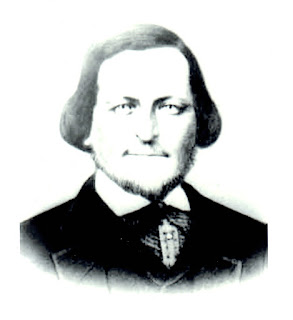
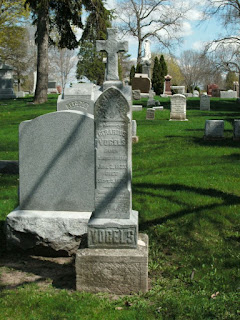
Gerardus Vogelzang, My 2nd Great-Grandfather


Topics we study in history books affected our ancestors in ways we may never realize. For most of my ancestors, I know little about them, but they are my history.


Gerardus Vogelzang, My 2nd Great-Grandfather

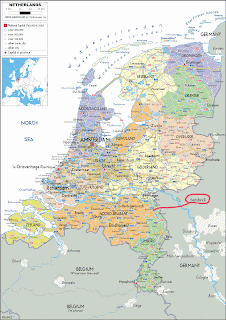
2 June 1823    Sambeek, Boxmeer, Noord-Brabant, Netherlands

5 Sept 1876    Green Bay, Wisconsin, USA


When I first began studying my family’s genealogy, I thought I had 3/4 German ancestry, 1/8 Belgian, and 1/8 French. Years later, I learned the Belgian and French Canadian were both 1/16, and I have 1/8 Dutch ancestry.

My great-great-grandfather Gerardus Vogelzang (bird song) had Americanized his name to George Vogels, making his history hard to trace. Once I knew he was Dutch, I found him on the CD, “Immigration Records, Dutch in America 1800s.”

He was born in Sambeek in southern Netherlands, close to the German border. In 1850, Sambeek had a population of about 1,300. At age 33 in 1857, George emigrated to America, hoping for economic improvement. He was a farmer, in the “less well to do” social class.

Some time in the next eight years, he married Theodora Maria Van der Heiden, now known as Mary Vogels. They had six children, the youngest being my great-grandmother Kate, born in 1875. According to the 1870 census, George’s three teenage nephews had come from the Netherlands and were living with the family. His brother and sister-in-law had died in 1867 and 1861. George too died in 1876, nineteen months after Kate was born.

Typical for widows with young children and a farm, Mary remarried a year later and had three more children.

One of my favorite genealogical websites for Dutch ancestry is https://www.wiewaswie.nl/en


Wednesday, January 26, 2022

Josephine Denis


Topics we study in history books affected our ancestors in ways we may never realize. For most of my ancestors, I know little about them, but they are my history.


Josephine Denis, My 2nd Great-Grandmother

21 Jan 1849   Grez-Doiceau, Belgium

21 April 1924    Green Bay, Wisconsin


For the longest time, Josephine was a mystery. From her marriage certificate, I learned her parents were Frank and Florence. From the 1860 census, I learned that as a 12-year-old, she lived with two men: a 40-year-old from Belgium and a 17-year-old from Holland. The men were laborers. She was a domestic. From that I surmised her family was poor and she had to work as a maid.

Then, a stroke of luck! Through a contact in Belgian research in 2018, this family line broke wide open. “Frank” and “Florence” were actually Jean Francois Denis and Marie Florence Vanschoelandt. (In France, Germany, and other Catholic countries, boys were given the first name Jean or Johan, and girls were named Marie or another saint’s name in the belief the saint would be a heavenly intercessor for them.)

The Denis family lived in Grez-Doiceau, Belgium, until Florence died in 1856. Frank and the children immigrated to Wisconsin and its thriving Belgian community, but then Frank sent his children away. Dispersing the children wasn’t uncommon when a parent died, but then why didn’t Frank stay in Belgium where he had family who may have helped?

I’ve learned what happened to Josephine’s two brothers. The 14-year-old served as a laborer with a young Canadian family in Fort Howard, near Green Bay. The younger brother lived with a Wisconsin woman and her two grown daughters who worked as seamstresses. It seems to me that Josephine would have had a better life living with the women for whom she could have learned a trade.

At the age of nineteen, she married Moses Martell. They had six children, at least four of whom grew to adulthood. One of them, Moses Jr., was my great-grandfather. I remember he always had pink and white mints for my sister and me.